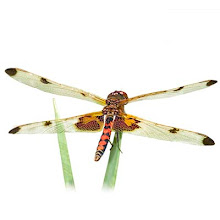
Common Green Darner (Anax junius)
April 15, 2008
A day of first sightings for 2008. I've never had a day when I've seen so many cool things combined with taking so few photographs – I spent much of the day trying to get close to Goatweed Leafwings (Anaea andria). They were jumpy enough that I was occasionally flushing them from 10-15 feet away.
For a list of first sightings of the year, I'll start with the one that felt the most like “summer's coming” -- Common Green Darner (Anax junius)! It's been a long 6 months – my last Missouri dragonfly was a Variegated Meadowhawk last October.
Another first for spring of 2008 was a Six-spotted Tiger Beetle (Cicindella sexguttata). And a few new butterflies (and a moth) for the year: Falcate Orangetip (Anthocharis midea), Orange Sulphur (Colias eurytheme), Gray Hairstreak (Strymon melinus), Henry's Elfin (Callophrys henrici), Red Admiral (Vanessa atalanta), Painted Lady (Vanessa cardui) and a Snowberry Clearwing (Hemaris diffinis) moth.
In addition to the easily startled leafwings, other butterfly behavior lead to the low number of photos. Butterflies were continually jumping up to chase other butterflies. At about 5:30 pm, there were several episodes of 5 individuals engaged in chases: a Painted Lady, a Red Admiral, and a Goatweed Leafwing taking turns at the front trailed by 2 unidentified spreadwing skippers.
Wednesday, April 16, 2008

Caterpillar
April 9, 2008
We decided to join Randal Clark's wildflower walk tonight, but typical of this spring, wildflower sightings were scarce. Someone on the group found a very tiny caterpillar on gooseberry. Unfortunately, it kind of looked like rain, so I left without my camera – and even without my phone!
April 9, 2008
We decided to join Randal Clark's wildflower walk tonight, but typical of this spring, wildflower sightings were scarce. Someone on the group found a very tiny caterpillar on gooseberry. Unfortunately, it kind of looked like rain, so I left without my camera – and even without my phone!
Monday, April 07, 2008
Zebra Swallowtail (Eurytides marcellus)
7 April, 2008
Saw a few butterflies for the first time this year – Spring Azures (Celestrina ladon) and a Zebra Swallowtail (Eurytides marcellus). There were also quite a few moths (Caenurgina sp.) flying over mowed grass along the trail. I also found 2 blister beetles (Meloe sp.) on the trail.
7 April, 2008
Saw a few butterflies for the first time this year – Spring Azures (Celestrina ladon) and a Zebra Swallowtail (Eurytides marcellus). There were also quite a few moths (Caenurgina sp.) flying over mowed grass along the trail. I also found 2 blister beetles (Meloe sp.) on the trail.
Sunday, April 06, 2008
Water Measurer (Hydrometra sp.)
5 April, 2008
SUN! After seemingly endless days of cloudy, rainy weather, we finally get a break.
I spent an hour and a half sitting at the edge of a pond watching water striders, backswimmers, water boatmen, and a variety of diving beetles. But the highlight came when I noticed a water measurer (Hydrometridae, Hydrometra sp.) walking across the water surface. It's the first time I've ever seen a member this family of insects other than in the Enns Entomology Museum. Maybe I haven't been looking closely enough, but in my defense, it was gray-brown and about the size of a sewing needle. While sitting at the pond, I heard an insect jump onto dried vegetation behind me. It was a froghopper (Cercopidae Lepyronia sp.)
I ended up with 5 butterfly species for the day – Cabbage White (Pieris rapae), Mourning Cloak (Nymphalis antiopa), Question Mark (Polygonia interrogationis), Eastern Comma (Polygonia comma), and Gray Comma (Polygonia progne). One of the Gray Commas was nectaring at Fragrant Sumac (Rhus aromatica).
5 April, 2008
SUN! After seemingly endless days of cloudy, rainy weather, we finally get a break.
I spent an hour and a half sitting at the edge of a pond watching water striders, backswimmers, water boatmen, and a variety of diving beetles. But the highlight came when I noticed a water measurer (Hydrometridae, Hydrometra sp.) walking across the water surface. It's the first time I've ever seen a member this family of insects other than in the Enns Entomology Museum. Maybe I haven't been looking closely enough, but in my defense, it was gray-brown and about the size of a sewing needle. While sitting at the pond, I heard an insect jump onto dried vegetation behind me. It was a froghopper (Cercopidae Lepyronia sp.)
I ended up with 5 butterfly species for the day – Cabbage White (Pieris rapae), Mourning Cloak (Nymphalis antiopa), Question Mark (Polygonia interrogationis), Eastern Comma (Polygonia comma), and Gray Comma (Polygonia progne). One of the Gray Commas was nectaring at Fragrant Sumac (Rhus aromatica).
Friday, March 21, 2008
Water Strider (Aquarius sp.)
March 21, 2008
A mix today of winter and spring sightings. While watching my first water striders of 2008, a White-throated Sparrow foraged on the ground nearby.
I have a new pet -- "Maggie" -- I collected one of the maggots I photographed yesterday. I have it in a plastic container with about 1" of dirt. I think it's a crane fly (Tipulidae), and will try to raise it to an adult to see what it looks like then.
March 21, 2008
A mix today of winter and spring sightings. While watching my first water striders of 2008, a White-throated Sparrow foraged on the ground nearby.
I have a new pet -- "Maggie" -- I collected one of the maggots I photographed yesterday. I have it in a plastic container with about 1" of dirt. I think it's a crane fly (Tipulidae), and will try to raise it to an adult to see what it looks like then.
Maggots
March 20, 2008
A great first day of spring – sunny and mid-60s. But while last week in Louisiana we were in the midst of spring with butterflies, dragonflies and other cool stuff, today I resorted to maggot photos and a photo of henbit which should soon be turning parts of the landscape purple. (Take a look at Daniel Spurgeon's Nature at Close Range blog entry on henbit.)
We did experience my favorite part of spring – extremely loud spring peepers. As we rode our bikes past flooded woods at 2 pm, we heard mostly chorus frogs with a few peepers. The return ride at 5:15 pm was mostly peepers with a few chorus frogs. I like both, but really prefer to hear the peepers. Kind of weird that someone who admits (yes, I'm embarrassed) to being creeped out by frogs, lizards, skinks . . . . thinks listening to them is the best part of spring.
And switching to birds -- my first Eastern Phoebe in Missouri this year.
March 20, 2008
A great first day of spring – sunny and mid-60s. But while last week in Louisiana we were in the midst of spring with butterflies, dragonflies and other cool stuff, today I resorted to maggot photos and a photo of henbit which should soon be turning parts of the landscape purple. (Take a look at Daniel Spurgeon's Nature at Close Range blog entry on henbit.)
We did experience my favorite part of spring – extremely loud spring peepers. As we rode our bikes past flooded woods at 2 pm, we heard mostly chorus frogs with a few peepers. The return ride at 5:15 pm was mostly peepers with a few chorus frogs. I like both, but really prefer to hear the peepers. Kind of weird that someone who admits (yes, I'm embarrassed) to being creeped out by frogs, lizards, skinks . . . . thinks listening to them is the best part of spring.
And switching to birds -- my first Eastern Phoebe in Missouri this year.
Southeast Louisiana
March 9 - 13, 2008
It was really nice to get an extra week of spring by driving out of winter. Some highlights of the trip were dragonflies and damselflies at Tickfaw State Park, including a Stream Cruiser (Didymops transversa) and lots of Fragile Forktails (Ischnura posita). The forktails were common everyplace we went – even in my parents' yard. Butterflies at Tickfaw included quite a few Southern Pearly-eyes (Enodia portlandia).
Everywhere we went – but especially Mandalay National Wildlife Refuge – had way more lizards than I cared to see. We also had to turn around on the Mandalay trail midway one day when we couldn't get around a water moccasin. We had lunch, and returned to the trail and then made it to the end since the snake had left the bridge it was sunning itself on. From the wharf at the end, we saw the biggest alligator I've ever seen while out hiking – I'd guess about 15' long.
The best sighting at Mandalay was a bee mimic robber fly (Laphria sp.). Unfortunately, I had to be satisfied with using a doubler on my lens, shooting from 8' away at an insect higher than my head and cropping the photos. But since it was the only one in the genus I'd ever seen, I was still glad to get the shot. We also saw a few skippers, including this Least Skipper (Ancyloxypha numitor) nectaring at a flower in the pea family.
My parents' yard also had several really cool assassin bugs in the genus Zelus.
March 9 - 13, 2008
It was really nice to get an extra week of spring by driving out of winter. Some highlights of the trip were dragonflies and damselflies at Tickfaw State Park, including a Stream Cruiser (Didymops transversa) and lots of Fragile Forktails (Ischnura posita). The forktails were common everyplace we went – even in my parents' yard. Butterflies at Tickfaw included quite a few Southern Pearly-eyes (Enodia portlandia).
Everywhere we went – but especially Mandalay National Wildlife Refuge – had way more lizards than I cared to see. We also had to turn around on the Mandalay trail midway one day when we couldn't get around a water moccasin. We had lunch, and returned to the trail and then made it to the end since the snake had left the bridge it was sunning itself on. From the wharf at the end, we saw the biggest alligator I've ever seen while out hiking – I'd guess about 15' long.
The best sighting at Mandalay was a bee mimic robber fly (Laphria sp.). Unfortunately, I had to be satisfied with using a doubler on my lens, shooting from 8' away at an insect higher than my head and cropping the photos. But since it was the only one in the genus I'd ever seen, I was still glad to get the shot. We also saw a few skippers, including this Least Skipper (Ancyloxypha numitor) nectaring at a flower in the pea family.
My parents' yard also had several really cool assassin bugs in the genus Zelus.
Tuesday, March 04, 2008
Micromoth
March 4, 2008
Sunny and almost 40. I saw a tiny (probably 3-4 mm wingspan) tan moth flying over a creek at about 3:30 in the afternoon. It landed in the water, swam a few inches and managed to climb out of the water onto a protruding rock. Given the water temperature and the way I was dressed, I opted not to jump into the creek for a closer look.
March 4, 2008
Sunny and almost 40. I saw a tiny (probably 3-4 mm wingspan) tan moth flying over a creek at about 3:30 in the afternoon. It landed in the water, swam a few inches and managed to climb out of the water onto a protruding rock. Given the water temperature and the way I was dressed, I opted not to jump into the creek for a closer look.
Goatweed Leafwing (Anaea andria)
March 2, 2008
When went back outside just before lunch, I noticed a small gray insect almost completely blending into the concrete. Fortunately, I'm constantly looking for insects because I'd have been really upset with myself if I had stepped on an antlion larva and then noticed it smashed on the pavement. I had been wondering if the warm weather would get a few of the antlions in our nesting area moving around, but this was the first time I'd seen one leave the loose dirt and crawl up a 4 inch vertical slab of concrete.
In the afternoon, we headed out to Henry Domke's reception for his photo exhibit at Runge Nature Center. As always, Henry's photos were brilliant, stunning. . . . While out on the trail (on this 77 degree day), we saw our first butterfly of the year – a female Goatweed Leafwing.
I left the deck light on in the evening to watch for moths, but the only visitors were two ichneumonid wasps similar to this one photographed in March 2007.
March 2, 2008
When went back outside just before lunch, I noticed a small gray insect almost completely blending into the concrete. Fortunately, I'm constantly looking for insects because I'd have been really upset with myself if I had stepped on an antlion larva and then noticed it smashed on the pavement. I had been wondering if the warm weather would get a few of the antlions in our nesting area moving around, but this was the first time I'd seen one leave the loose dirt and crawl up a 4 inch vertical slab of concrete.
In the afternoon, we headed out to Henry Domke's reception for his photo exhibit at Runge Nature Center. As always, Henry's photos were brilliant, stunning. . . . While out on the trail (on this 77 degree day), we saw our first butterfly of the year – a female Goatweed Leafwing.
I left the deck light on in the evening to watch for moths, but the only visitors were two ichneumonid wasps similar to this one photographed in March 2007.
Overwintering
March 1, 2008
A warm (69 F), sunny day. I wasn't seeing much on our bike ride, so in desperation I started lifting pieces of bark on the ground below a tree and found an overwintering beetle larva. I also had a fly buzz my bright green and white helmet, but since I was still wearing my helmet, I didn't get a good look at it.
Chorus frogs were calling this afternoon.
March 1, 2008
A warm (69 F), sunny day. I wasn't seeing much on our bike ride, so in desperation I started lifting pieces of bark on the ground below a tree and found an overwintering beetle larva. I also had a fly buzz my bright green and white helmet, but since I was still wearing my helmet, I didn't get a good look at it.
Chorus frogs were calling this afternoon.
Friday, February 29, 2008
February 29, 2008
A warm day, but a search of Peace Park didn't turn up any insects. As usual on any warm day in winter, I found a few Red-shouldered Bugs outside Jesse Hall. I also had a winter crane fly land on a book I was reading outside.
I've been reading Enjoying Moths by Roy Leverton. The book was published in Great Britain, so it's mostly about British moths. Here's a great quote from the chapter discussing European moths that have become established in North America:
“Some moths (or rather their caterpillars) have been given common names, such as Apple Leaf Skeletonizer Chloreutis pariana and Omnivorous Leaf-tier Cnephasia longana, reflecting an American tendency to see moths as enemies rather than as wildlife. After it was introduced, our Rosy Rustic became their Potato Stem Borer!”
A warm day, but a search of Peace Park didn't turn up any insects. As usual on any warm day in winter, I found a few Red-shouldered Bugs outside Jesse Hall. I also had a winter crane fly land on a book I was reading outside.
I've been reading Enjoying Moths by Roy Leverton. The book was published in Great Britain, so it's mostly about British moths. Here's a great quote from the chapter discussing European moths that have become established in North America:
“Some moths (or rather their caterpillars) have been given common names, such as Apple Leaf Skeletonizer Chloreutis pariana and Omnivorous Leaf-tier Cnephasia longana, reflecting an American tendency to see moths as enemies rather than as wildlife. After it was introduced, our Rosy Rustic became their Potato Stem Borer!”
Thursday, February 14, 2008
Impatient for Spring
February 14, 2008
Since I'm getting impatient for spring, I decided to look back at some of my late winter / early spring photos. Syrphid flies were at blooming Witch-hazel on February 15, 2005. On February 29, 2004, I took photos of a water strider in Flat Branch Creek. My first butterflies last year were Question Marks that came to bait on trees in our backyard on March 12th.
I'm going to try to be much more diligent about updating my blog this year, noting when I see new insects as we move from winter into spring. I've already seen a few flies in January, and a couple of Asian ladybugs and box elder bugs crawling over the exterior walls of our house on warm days.
February 14, 2008
Since I'm getting impatient for spring, I decided to look back at some of my late winter / early spring photos. Syrphid flies were at blooming Witch-hazel on February 15, 2005. On February 29, 2004, I took photos of a water strider in Flat Branch Creek. My first butterflies last year were Question Marks that came to bait on trees in our backyard on March 12th.
I'm going to try to be much more diligent about updating my blog this year, noting when I see new insects as we move from winter into spring. I've already seen a few flies in January, and a couple of Asian ladybugs and box elder bugs crawling over the exterior walls of our house on warm days.
Sunday, January 27, 2008
Red-shouldered Bugs (Jadera haematoloma)
January 7, 2008
I went for a walk on campus on this warm and sunny winter day (49 degrees). I saw several Red-shouldered Bugs (Jadera haematoloma) crawling around at the most reliable spot for them on campus – at the Goldenrain Tree (Sapindaceae Koelrueteria paniculata) just outside the doors of Jesse Hall. The insect is believed to be native to North America, but they are so frequently observed at exotic Goldenrain Trees that another common name is Goldenrain Tree Bug.
No photos from today, but here is an image of a Red-shouldered Bug on a Goldenrain Tree seed pod near Jesse Hall on 8 November 2005.
January 7, 2008
I went for a walk on campus on this warm and sunny winter day (49 degrees). I saw several Red-shouldered Bugs (Jadera haematoloma) crawling around at the most reliable spot for them on campus – at the Goldenrain Tree (Sapindaceae Koelrueteria paniculata) just outside the doors of Jesse Hall. The insect is believed to be native to North America, but they are so frequently observed at exotic Goldenrain Trees that another common name is Goldenrain Tree Bug.
No photos from today, but here is an image of a Red-shouldered Bug on a Goldenrain Tree seed pod near Jesse Hall on 8 November 2005.
Winter Crane Flies (Trichoceridae)
December 25, 2007
We were in Columbia on a sunny and 45 degree Christmas day this year. While walking on the MKT Trail, we saw a group of winter crane flies hovering above Flat Branch Creek, and several other individuals at different bridges over the creek. Unfortunately, when I left the house, although I thought about the possibility of finding a few insects, I figured it was a long shot and decided to walk without carrying a ton of camera equipment. Which was why I ended up taking a photo with my phone!!! You can take a look at it, along with a real photo of a winter crane fly taken 20 November 2006.
December 25, 2007
We were in Columbia on a sunny and 45 degree Christmas day this year. While walking on the MKT Trail, we saw a group of winter crane flies hovering above Flat Branch Creek, and several other individuals at different bridges over the creek. Unfortunately, when I left the house, although I thought about the possibility of finding a few insects, I figured it was a long shot and decided to walk without carrying a ton of camera equipment. Which was why I ended up taking a photo with my phone!!! You can take a look at it, along with a real photo of a winter crane fly taken 20 November 2006.
Monday, November 12, 2007
Common Checkered-Skipper (Pyrgus communis)
October 30, 2007
Back to the same clump of asters today, but not quite as good as it was on the 21st. Still fair numbers of sulphurs and skippers. Here's a photo of one of the Common Checkered-Skippers which are always so much easier to find at the end of the flight season instead of during the middle of the summer.
The bait pulled in a Gray Comma, but I didn't get a second chance at the Goatweed Leafwing.
October 30, 2007
Back to the same clump of asters today, but not quite as good as it was on the 21st. Still fair numbers of sulphurs and skippers. Here's a photo of one of the Common Checkered-Skippers which are always so much easier to find at the end of the flight season instead of during the middle of the summer.
The bait pulled in a Gray Comma, but I didn't get a second chance at the Goatweed Leafwing.
Orange Sulphur (Colias eurytheme)
October 21, 2007
Wow! I stopped by a small clump of aromatic asters in Boone County today and it was the best place for insects that I'd been at in a month! I think I really demonstrated the temperament of a macro photographer today – I stayed within a 10' diameter circle from 10:30 am until 4 pm.
Butterflies included Little Yellow (Eurema lisa), Orange Sulphur (Colias eurytheme), Clouded Sulphur (Colias philodice), Red-Banded Hairstreak (Calycopis cecrops), Juniper Hairstreak (Callophrys gryneus), Pearl Crescent (Phyciodes tharos), Common Buckeye (Junonia coenia), and Goatweed Leafwing (Anaea andria). Skippers included Sachem (Atalopedes campestris), Fiery Skipper (Hylephila phyleus), and Common Checkered-Skipper (Pyrgus communis). Moths included Yellow-collared Scape Moth (Cisseps fulvicollis), Hawaiian Beet Webworm Moth (Spolodea recurvalis) and Spotted Beet Webworm Moth (Hymenia perspectalis – here's a photo of this species from September).
My favorite image from today is this photo of a male Orange Sulphur engaging in courtship behavior with a female. The male is flying above the perched female. The female wasn't interested and is expressing that to the male by lifting her abdomen into the air.
The Goatweed Leafwing was attracted to bait I had put on several trees near the asters. I wish people who are afraid to get close to wasps could have seen how docile these wasps at the bait were. I had placed the mostly empty container on the ground. When I was ready to leave, I went over to pick it up – it was covered in flies, yellowjackets and paper wasps. I just grabbed the container and shook it to knock everyone off. Then I decided I should have taken a few photos, so I put it back on the ground and waited a moment. Several immediately returned, included this paper wasp.
October 21, 2007
Wow! I stopped by a small clump of aromatic asters in Boone County today and it was the best place for insects that I'd been at in a month! I think I really demonstrated the temperament of a macro photographer today – I stayed within a 10' diameter circle from 10:30 am until 4 pm.
Butterflies included Little Yellow (Eurema lisa), Orange Sulphur (Colias eurytheme), Clouded Sulphur (Colias philodice), Red-Banded Hairstreak (Calycopis cecrops), Juniper Hairstreak (Callophrys gryneus), Pearl Crescent (Phyciodes tharos), Common Buckeye (Junonia coenia), and Goatweed Leafwing (Anaea andria). Skippers included Sachem (Atalopedes campestris), Fiery Skipper (Hylephila phyleus), and Common Checkered-Skipper (Pyrgus communis). Moths included Yellow-collared Scape Moth (Cisseps fulvicollis), Hawaiian Beet Webworm Moth (Spolodea recurvalis) and Spotted Beet Webworm Moth (Hymenia perspectalis – here's a photo of this species from September).
My favorite image from today is this photo of a male Orange Sulphur engaging in courtship behavior with a female. The male is flying above the perched female. The female wasn't interested and is expressing that to the male by lifting her abdomen into the air.
The Goatweed Leafwing was attracted to bait I had put on several trees near the asters. I wish people who are afraid to get close to wasps could have seen how docile these wasps at the bait were. I had placed the mostly empty container on the ground. When I was ready to leave, I went over to pick it up – it was covered in flies, yellowjackets and paper wasps. I just grabbed the container and shook it to knock everyone off. Then I decided I should have taken a few photos, so I put it back on the ground and waited a moment. Several immediately returned, included this paper wasp.
Variegated Meadowhawk (Sympetrum corruptum)
October 11, 2007
We were out for a bike ride when I had to swerve around this Black Swallowtail caterpillar (Papilio polyxenes) crossing the trail, presumably out searching for a suitable pupation site to spend the winter.
I've also been noticing a group of Variegated Meadowhawks (Sympetrum corruptum) and managed to get a photo of this one resting on the trail.
October 11, 2007
We were out for a bike ride when I had to swerve around this Black Swallowtail caterpillar (Papilio polyxenes) crossing the trail, presumably out searching for a suitable pupation site to spend the winter.
I've also been noticing a group of Variegated Meadowhawks (Sympetrum corruptum) and managed to get a photo of this one resting on the trail.
Gray Comma (Polygonia progne)
October 9, 2007
My bait finally attracted a Gray Comma. I've been getting Question Marks and Eastern Commas, along with a variety of other insects. It was especially nice to get today, since the numbers of insects has started to drop as we move into fall. Other insects for the day included Question Mark (Polygonia interrogationis), Gray Hairstreak (Strymon melinus), Red-Banded Hairstreak (Calycopis cecrops), Little Yellow (Eurema lisa), Fiery Skipper (Hylephila phyleus), Common Checkered-Skipper (Pyrgus communis), Sachem (Atalopedes campestris), Eastern Pondhawk (Erythemis simplicicollis), Variegated Meadowhawk (Sympetrum corruptum) and an unidentified red male meadowhawk (Sympetrum sp.) I also briefly saw one of the rainpool gliders (Pantala sp.) but, typical for these guys, I never saw it land so I could get a good photo or at least a look to identify it to species.
October 9, 2007
My bait finally attracted a Gray Comma. I've been getting Question Marks and Eastern Commas, along with a variety of other insects. It was especially nice to get today, since the numbers of insects has started to drop as we move into fall. Other insects for the day included Question Mark (Polygonia interrogationis), Gray Hairstreak (Strymon melinus), Red-Banded Hairstreak (Calycopis cecrops), Little Yellow (Eurema lisa), Fiery Skipper (Hylephila phyleus), Common Checkered-Skipper (Pyrgus communis), Sachem (Atalopedes campestris), Eastern Pondhawk (Erythemis simplicicollis), Variegated Meadowhawk (Sympetrum corruptum) and an unidentified red male meadowhawk (Sympetrum sp.) I also briefly saw one of the rainpool gliders (Pantala sp.) but, typical for these guys, I never saw it land so I could get a good photo or at least a look to identify it to species.
Tuesday, October 09, 2007
Preying Mantis Egg Case (Mantodea)
October 5, 2007
I managed to take this photo of a praying mantis egg case while fighting the wind which not only kept making my photo out of focus, but was frequently pushing the entire plant with the egg case out of the field of view of my lens. I expect the eggs will overwinter and hatch in the spring.
October 5, 2007
I managed to take this photo of a praying mantis egg case while fighting the wind which not only kept making my photo out of focus, but was frequently pushing the entire plant with the egg case out of the field of view of my lens. I expect the eggs will overwinter and hatch in the spring.
Subscribe to:
Posts (Atom)